AI badminton coaching: what video can — and can't — see
Video can reveal every shot, movement pattern, and missed corner. The harder question is what those signals mean — and what a player should do next.
What to take away
- Video analysis is already strong at shot classification, court position, trajectory, rally tempo, and repeated-pattern detection.
- The camera records what happened; it does not reliably reveal intent, pressure, decision quality, or the tactical relationship with an opponent.
- The useful model is AI as the analyst and a coach — or an informed player — as the strategist.
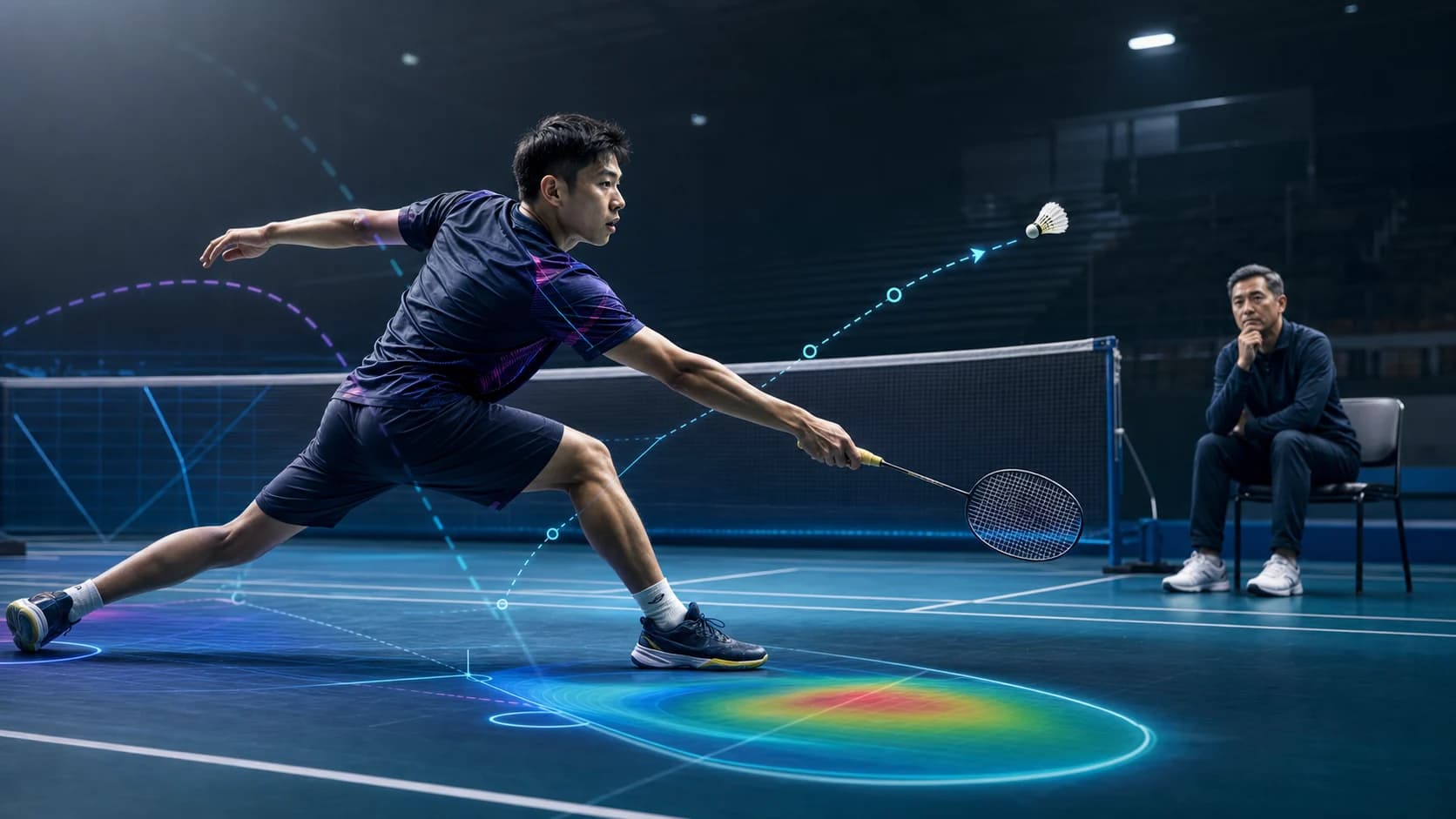
Computer vision can do a lot in 2026. It can watch a 90-minute match video, count every shot, classify it as a smash or a clear or a drop, plot where on the court each point landed, and generate a heatmap of your movement around the court. It can do this from a phone recording, in a few minutes.
What it can't do — yet — is replace your coach. Here's the line, drawn in good faith by people who've spent the last year building goSmash, an AI coaching app for badminton players. We've shipped the wins, hit the limits, and figured out where the boundary actually sits. This post is what we wish someone had told us when we started.
What AI video analysis can see well today
Shot classification. Identifying a shot as a smash, clear, drop, lift, push, net shot, or drive is a solved problem at the level of the typical club player. Models trained on thousands of professional and amateur match clips classify the seven main shot types reliably on clear footage. This includes counting shots over the course of a match — total smashes hit, total drops won, total clears that were attacked.
Court position and movement. Tracking where a player is at any moment of the rally is reliable. The output is a heatmap of court coverage that tells you, with no ambiguity, that you spent 60% of the match in your back-left quadrant and only 7% at the front of the court. That's actionable. You can't argue with the heatmap.
Shot trajectory. Where the shuttle landed (front court, mid court, back court, in or out, sideline edge) is well within reach of vision models. Most consumer apps show you a point-by-point map of where your shots ended up versus where your opponent's did.
Tempo and rally length. How long your average rally lasted, how it compared to your opponent's, where in the match the longest rallies happened. All trivially available from the raw video timing.
Repeated patterns. The thing the human eye misses but the AI catches: "you played 14 cross-court drops in the first game, all from your forehand corner, and your opponent attacked 11 of them." Patterns over the course of a match are where computer vision quietly outperforms human memory.
What AI video analysis can't see — yet
Why you played the shot. The model sees that you hit a clear. It doesn't know whether you hit a clear because (a) it was the right shot, (b) you'd run out of time and were defending, (c) you panicked and hit the safest thing, or (d) your coach told you to attack but you got nervous. These four reasons are the entire content of a coaching conversation. None of them are visible in the video.
Decision quality. Adjacent to the above. The shot you played might have been a smash — and the smash might have been the wrong shot. Better would have been a tight net shot. AI can tell you the smash went in. It can't tell you that the better player would have played the net shot.
This matters because "hit better smashes" is rarely the advice a player needs. The advice they usually need is "choose better shots in this kind of position." That's a coaching skill, and the data the AI sees doesn't contain it.
The mental layer. You played four bad shots in a row. Was that nerves? Fatigue? Tactical confusion? An adjustment your opponent made that you didn't read? The AI shows you that the bad streak happened. A coach figures out why and works on it.
The body story. A small lean of the upper body before a smash that telegraphs to a sharp opponent. A planted foot that stops you reaching the next shot. The half-second of hesitation before a deceptive shot. These are visible in the video, but no current model is reliably extracting them at the level a good coach catches at first viewing.
The opponent. This is the big gap. Most consumer AI coaching focuses on you. Coaches focus on you against this specific opponent. Reading patterns in your opponent's play and adjusting tactically is the highest-leverage coaching insight in match-play, and it's almost untouched by current AI tools.
Where the combination is the answer
The useful division of labour: AI as the analyst, human as the strategist.
This is the pattern goSmash is built around. The AI counts the shots, builds the heatmap, surfaces the patterns, and pulls up the three rallies most worth re-watching. The coach (or your own informed judgement) reads those, decides what they mean, and decides what to work on next.
A common training session that uses both: the AI shows you that 60% of your unforced errors came on your backhand defensive clear. You and your coach watch the seven specific clips it surfaced. Your coach says "you're rushing the racket head — your prep is collapsing under pressure." You spend the next training session drilling that specific motion.
Before AI, the coach had to watch the whole match to find those seven clips. Now they don't. They get to spend their hour on the part only they can do: figuring out why and what to do about it. The role doesn't go away. It compresses to the most valuable thirty minutes.
Where this is going (the next two years)
The boundaries will move. We expect:
- Decision-quality classifiers, trained on professional matches with shot-level annotations from coaches, that can distinguish "right shot, right execution" from "wrong shot, right execution" — at least for the obvious cases.
- Opponent-aware analysis that tracks your opponent's patterns alongside yours, so the AI can surface tactical openings, not just personal patterns.
- Real-time feedback during training, not just post-match — shot-by-shot guidance that arrives between points.
- Body-mechanics breakdowns that reach the level a competent coach catches at first viewing. Pose estimation is good enough; the missing piece is taste-trained models that know which body cues matter.
What probably won't happen in this timeframe: an AI replacing the human coach. The job will keep changing. The job will not disappear.
What this means if you're a player
If you have a coach: AI tools like goSmash make your hour with them more valuable, not less. Bring the analysis. Watch the highlighted clips together. Spend the hour on what the analysis can't do.
If you don't have a coach: AI tools fill the gap that says "someone watched my match and told me what was happening." That's real, and it's the largest gap in self-coached badminton. They don't fill the gap that says "someone with taste decided what I should work on next." For that, you're still on your own — but you'll be on your own with vastly better data than anyone had ten years ago.
If you play badminton and want to see what AI analysis of your own match looks like, goSmash is in invite-only beta. Ask for access, upload a match video, and get the breakdown back in a few minutes to see what your patterns actually are.
Written by Anil Dongre, Founder, Think and Form Limited.
Keep reading
- AI in construction: 7 workflows worth automating in 2026
- From prototype to production: 5 things every AI-built MVP misses
- AI receptionists for NZ small businesses: where voice agents help, and where they fail